categories:
- smoke-sessions
Overview
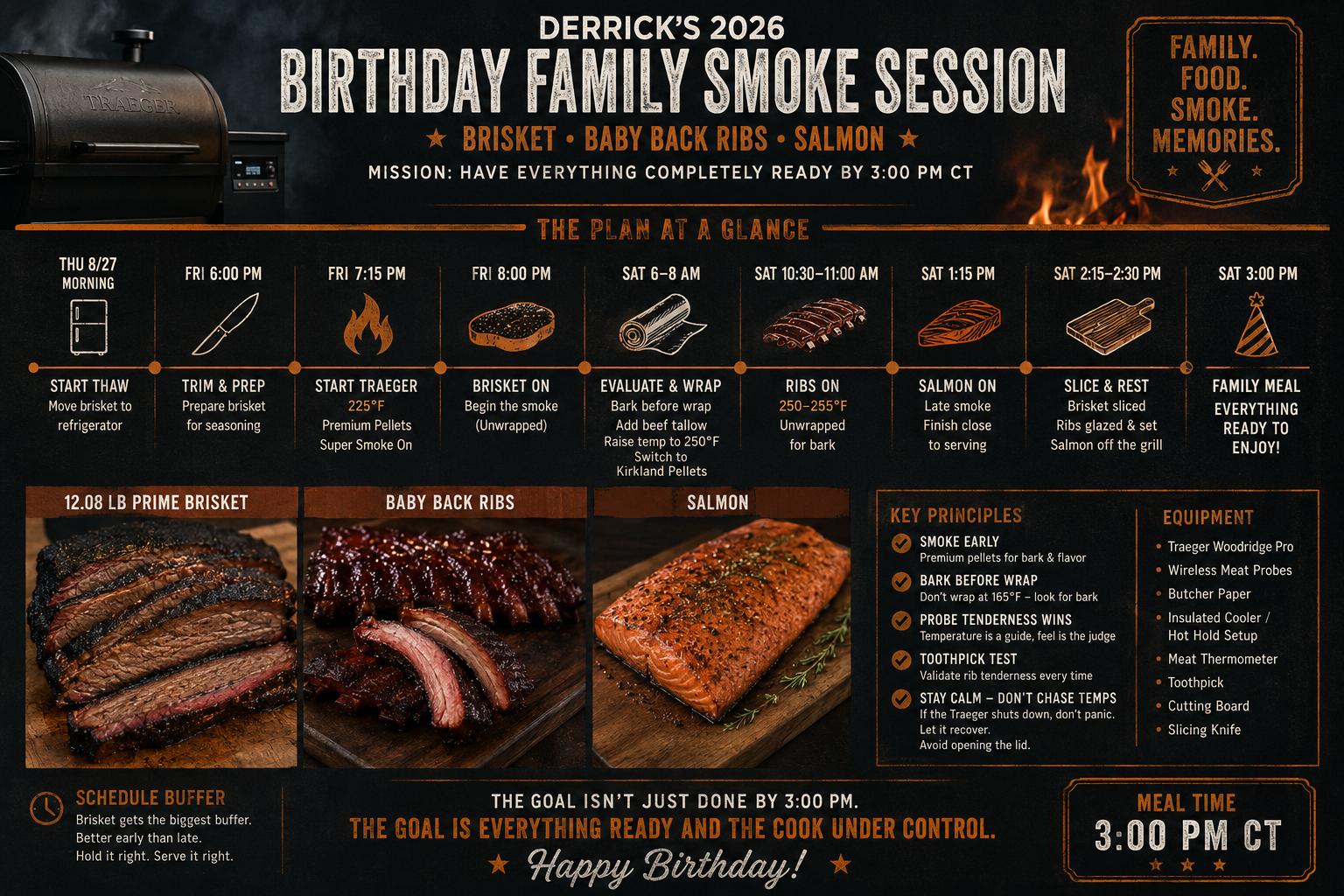
A family birthday smoke session built around a 12.08 lb Prime brisket, baby back ribs, and salmon.
The primary objective is to have the complete meal ready for the 3:00 PM CT family birthday meal while maintaining enough schedule margin for the brisket to finish naturally.
The brisket controls the schedule. The ribs and salmon are scheduled around it.
This cook also establishes the first measured brisket resting and hot-hold timeline for future cooks — including a real mid-hold complication (probe displacement) and how it was diagnosed and corrected.
Ingredients
Brisket
- 12.08 lb Prime brisket
- Kosher salt
- Coarse black pepper
- Supporting beef rub
- Rendered beef tallow
- Butcher paper
Baby Back Ribs
- 1 rack baby back ribs
- Rib seasoning
- BBQ glaze
Salmon
- Salmon
- Standard salmon preparation/seasoning
Equipment
- Traeger Woodridge Pro
- Wireless meat probes
- Butcher paper
- Insulated cooler / hot-hold setup
- Meat thermometer
- Toothpick for rib tenderness testing
- Cutting board
- Brisket slicing knife
Instructions
1. Begin Brisket Thaw
Thursday Morning
Move the frozen 12.08 lb brisket from the freezer to the refrigerator.
Keep the brisket:
- In its packaging
- On a tray or pan
- On the bottom refrigerator shelf
- Refrigerated throughout the thaw
Target approximately 36 hours of refrigerator thawing before Friday evening preparation.
Thaw Validation
Check the brisket Friday morning and again Friday afternoon.
If the center remains substantially frozen, continue safe thawing rather than leaving the brisket at room temperature.
2. Prepare Brisket
Friday — ~6:00 PM
Remove brisket from refrigerator.
Perform final trimming.
Remove:
- Hard exterior fat
- Large pockets of hard internal fat
- Loose pieces likely to burn
Preserve sufficient fat to protect the flat.
3. Season Brisket
Friday — ~6:30–7:00 PM
Apply final seasoning.
Baseline:
- Kosher salt
- Coarse black pepper
- Supporting beef rub
4. Start Traeger
Friday — ~7:15 PM
Start Traeger.
Set:
225°F
Use premium smoke pellets during the early smoke phase:
- Smokin’ Pecan
- B&B Championship Blend
Enable Super Smoke during the early smoke phase.
5. Brisket Goes On
Friday — ~8:30 PM
Place brisket on the Traeger.
Insert wireless probe into the brisket.
The cook ultimately demonstrated that the brisket could move quickly once wrapped, so the earlier start provided useful holding margin.
6. Overnight Smoke
Friday ~8:30 PM → Saturday Morning
Maintain approximately:
225°F
Keep brisket unwrapped during the initial smoke/bark-development phase.
Primary objectives:
- Smoke flavor
- Bark development
- Initial fat rendering
Do not chase temperature.
Do not repeatedly open the lid.
7. Evaluate Brisket Bark
Saturday — ~6:15 AM
Check brisket.
Observed:
Bark looked good.
The bark was considered ready for wrapping.
This reinforces the established rule:
Bark before wrap.
Do not automatically wrap at 165°F.
8. Prepare Ribs and Raise Temperature
~6:15 AM
Season baby back ribs.
Raise Traeger temperature to:
250°F
9. Wrap Brisket
~6:30 AM
Melt rendered beef tallow.
Use rendered tallow from the previous smoke session.
Wrap brisket tightly in butcher paper with tallow.
Return to Traeger at:
250°F
Pellet Strategy
Premium pellets were used during the early smoke/bark phase.
Economical hardwood pellets may be used after wrapping because the wrapped phase is primarily a controlled cooking/finishing phase.
10. Add Baby Back Ribs
~6:30 AM
Place baby back ribs on the bottom rack.
The larger baby back ribs were intentionally positioned below the brisket so they could receive drippings from the brisket cook.
11. Monitor Brisket
~7:00 AM
Brisket:
172°F
~7:15 AM
Brisket:
181°F
~7:32 AM
Brisket:
188°F
The brisket was moving rapidly through the wrapped finishing phase.
At this point, temperature was used as an indicator while probe tenderness remained the completion standard.
12. Determine Brisket Completion
Brisket completion is based on probe tenderness, not a fixed internal temperature.
Expected tenderness window:
~198–205°F
But the brisket may be ready outside that range.
Pull Criteria
- Probe enters the flat with very little resistance.
- Point is tender.
- Flat has rendered sufficiently.
- Meat feels soft rather than tight or rubbery.
Temperature tells us where the brisket is.
Probe feel tells us whether it is done.
13. Brisket Rest / Cooler Hold
Saturday — 8:50 AM
Brisket removed from the Traeger and placed into the insulated cooler.
Wireless probe remained in the brisket.
Initial recorded rest temperature:
195°F at 8:52 AM
This establishes the beginning of the measured resting timeline.
Brisket Resting & Hold Timeline — Validated Cook Data
| Time | Brisket Internal Temp | State / Action |
|---|---|---|
| 8:50 AM | — | Placed in cooler with probe |
| 8:52 AM | 195°F | Initial recorded post-pull temperature |
| 9:10 AM | 193.8°F | Cooler hold |
| 11:05 AM | 162.3°F | Cooler hold |
| 12:45 PM | 143°F | Cooler hold, approaching slicing range |
| 1:17 PM | 136°F | Continued drop after brisket placed in 170°F oven — flagged as unexpected |
| — | — | Diagnosed: probe had shifted position, giving an inaccurate/lagging read |
| — | — | Probe reseated in correct position (thick part of flat/point, off bone and fat) |
| — | — | Towels removed from around brisket so oven air could reach the wrap directly |
| 1:46 PM | 137.8°F | Confirmed rising with probe reseated — oven turned off, brisket returned to cooler in towels |
| 3:00 PM target | — | Birthday meal |
Observed Cooler Cooling (Initial Rest)
From approximately:
195°F → 143°F
the brisket lost approximately:
52°F
over roughly 4 hours of cooler rest (8:52 AM–12:45 PM), confirming the earlier baseline: the brisket stayed well above 160°F until after 11:00 AM and only approached ~140°F close to 1:00 PM.
The Probe Displacement Event
At 1:17 PM, with the brisket in a 170°F oven specifically to arrest the decline, the reading kept falling (143°F → 136°F). This was correctly identified as a probe issue rather than an actual heat-loss problem — an active 170°F oven should not produce a continued temperature drop in the meat.
Root cause: the wireless probe had shifted out of position, likely toward a fat pocket, the surface, or partial withdrawal — any of which produces a false low/lagging reading.
Corrective actions taken, in order:
- Reseated the probe properly in the thickest part of the brisket, avoiding bone and fat pockets.
- Removed the brisket from its towel bundle (it was still nested in towels inside the oven, which insulated it from the oven’s own heat — effectively fighting the recovery attempt).
- Left the brisket on a tray, wrap intact, directly exposed to oven air.
- Rechecked after ~5–10 minutes.
Once corrected, the brisket rose from 136°F to 137.8°F by 1:46 PM, confirming the probe — not the meat — had been the source of the falling reading.
Return to Cooler
With the reading confirmed rising and the brisket close to target, the oven was turned off and the brisket was rewrapped in towels and returned to the cooler for a final, more predictable hold into the 3:00 PM service window, rather than left in a powered-off, uninsulated oven cavity.
14. Controlled Oven Hold — Lessons Refined
The original technique (place brisket in a 170°F oven when the cooler hold approaches the slicing range) worked, but this cook surfaced two refinements:
- Verify the probe is seated correctly before trusting a “still dropping in a hot oven” reading. A continued decline while under active heat is a strong signal of probe displacement, not actual temperature loss — check placement before assuming the hold technique has failed.
- Remove insulating towels before using the oven as an active recovery method. Towels that helped during the passive cooler hold will block oven air from reaching the meat and undermine an active reheat. Keep any tight butcher-paper/foil wrap on the meat itself, but strip outer insulation (towels) while it’s in the oven.
Once corrected, the 170°F oven again performed as expected: it reversed the decline and brought the brisket back into the target range within about 30 minutes.
15. Return Brisket to Cooler
After the controlled oven hold (and probe correction) brought the brisket back to 137.8°F and rising, the brisket was rewrapped in towels and placed back into the insulated cooler to hold through to the 3:00 PM meal.
Future Hold Strategy
For future cooks:
- Pull brisket when probe tender.
- Record pull temperature.
- Place probe in brisket and verify placement (thick part of flat/point, off bone/fat).
- Begin insulated cooler hold.
- Track the cooling curve.
- When the brisket approaches the preferred slicing range, evaluate whether to:
- Slice soon, or
- Briefly use a controlled oven hold.
- If using an oven hold, remove outer towels/insulation so oven heat actually reaches the meat, and re-verify probe placement if the reading behaves unexpectedly (e.g., still falling under active heat).
- Return to cooler (rewrapped) only once the recovery is confirmed and additional holding time is still needed.
This is preferable to assuming a cooler provides a fixed number of safe or quality-preserving hours, and preferable to troubleshooting the oven/technique before first ruling out a probe placement issue.
16. Finish Baby Back Ribs
The baby backs continued cooking at approximately:
250°F
One rack reached approximately:
196°F
and was already showing meat falling from the bone.
This cook therefore produced a very tender, non-competition-style rib result.
During the brisket’s oven recovery troubleshooting, the ribs were temporarily pulled from the oven (already resting, unwrapped) so the oven could be used solely for the brisket, then returned to the powered-off oven afterward. Being unwrapped, the ribs tolerated this without a drying concern given the short window involved.
Validation
The toothpick test remains the preferred tenderness check.
However, visible meat separation and excessive tenderness are also important observations.
Decision
Remove ribs when desired tenderness is reached.
Do not continue cooking simply to reach a particular temperature.
17. Glaze Baby Back Ribs
Glaze ribs near completion.
Return to smoker briefly as needed to set the glaze.
Target:
- Glaze bonded to surface
- Tender interior
- No unnecessary additional cooking
For this family cook, fall-apart tenderness is acceptable even though it is not competition-style bite.
18. Prepare Salmon
The salmon remained partially frozen later in the cook.
Because of the compressed thaw window, the salmon was prepared for a low-temperature Traeger smoke rather than true cold smoking.
Important Terminology
180°F is not cold smoking.
It is a low-temperature/hot smoke.
19. Smoke Salmon
~12:30 PM
Place prepared salmon on Traeger.
Set:
180°F
Enable:
Super Smoke
The partially frozen salmon was allowed to thaw and cook gradually in the smoker.
The original target was approximately:
1:00 PM
but completion should be determined by the salmon’s actual condition and internal temperature rather than an arbitrary clock deadline.
Future Improvement
For future birthday/family cooks:
Begin salmon thawing earlier.
Preferred approach:
- Refrigerator thaw well in advance.
- Confirm fully thawed before smoking.
- Use cold-water thawing only when additional thawing is necessary and cook immediately afterward.
20. Final Meal Preparation
~2:00–2:30 PM
Begin final preparation:
- Check brisket hold
- Slice brisket when appropriate
- Slice ribs
- Finish salmon
- Transfer food to serving platters
21. Final Ready State
~2:45 PM
All food should be:
- Cooked
- Properly held/rested
- Sliced
- Plated
- Ready to serve
No major cooking operation should remain.
22. Birthday Meal
3:00 PM
Family Birthday Smoke
Serve:
- Prime brisket
- Baby back ribs
- Smoked salmon
Derrick’s Notes
Why this recipe is interesting
This cook validated the value of starting the brisket early.
The brisket went on at approximately:
8:30 PM Friday
and was ready for the cooler at:
8:50 AM Saturday
This created a substantial schedule buffer before the 3:00 PM meal — and that buffer is what absorbed the mid-hold probe complication without threatening the serving time.
The Resting Timeline Is Now a Measured Baseline
This cook provides actual temperature data rather than a theoretical resting estimate, including a real anomaly and its resolution.
Recorded
8:52 AM — 195°F
↓
9:10 AM — 193.8°F
↓
11:05 AM — 162.3°F
↓
12:45 PM — 143°F
↓
1:17 PM — 136°F (probe displacement, false/lagging low reading, in 170°F oven)
↓ (probe reseated, towels removed)
1:46 PM — 137.8°F, confirmed rising
The brisket therefore remained above 160°F until after 11:00 AM, approached the preferred ~140°F slicing temperature around 1:00 PM, and required one round of active troubleshooting (probe placement) before the oven hold behaved as expected.
Important Holding Lesson
Do not define a brisket hold only by elapsed hours.
Instead track:
Pull temperature → cooler temperature curve → desired slicing temperature
The cooler’s performance depends on:
- Brisket size
- Starting temperature
- Wrapping method
- Cooler characteristics
- Insulation
- Ambient conditions
- Whether the cooler is opened
Therefore, the measured internal temperature is more useful than a generic “hold for X hours” rule.
New: Trust the Physics, Then Check the Probe
If a brisket in a cooler is dropping, that’s expected and consistent with physics.
If a brisket in an active heat source (like a 170°F oven) keeps dropping, that is not consistent with physics — treat it as a strong signal to check probe placement before assuming the technique isn’t working or extending the active-heat time unnecessarily.
Controlled Hold Lesson
The oven set to 170°F successfully reversed the brisket’s downward temperature trend — twice: once as designed, and a second time after the probe was corrected mid-troubleshooting.
Two things made the second reversal work where the first attempt appeared to fail:
- Confirming probe placement rather than trusting a reading that didn’t match the physics of active heating.
- Removing outer towel insulation so the oven’s heat could actually reach the wrapped brisket.
This provides a future option when:
- Brisket finishes very early.
- Cooler hold is bringing the brisket too close to the preferred slicing range.
- Meal service is still several hours away.
The controlled oven hold should be treated as a temperature-management technique, not as a replacement for the cooler/resting process — and as a technique that depends on accurate probe placement and unobstructed heat contact to actually work.
Brisket Scheduling Philosophy
The birthday cook validates:
Finish early. Hold properly. Serve calmly.
The brisket should not be scheduled to finish at meal time.
The schedule should instead provide enough margin to allow:
- Natural cooking
- Probe-tender pull
- Cooler rest
- Temperature monitoring
- Controlled holding if necessary
- Troubleshooting an unexpected reading without panicking, thanks to schedule margin
- Final slicing close to service
Rib Lesson
One rack became meat-falling-off-the-bone at approximately 196°F.
For future family cooks:
Tenderness wins over temperature.
Competition-style bite is not always the objective.
For a family birthday cook, exceptionally tender ribs may be preferred.
Unwrapped ribs resting in a warm/cooling oven tolerate brief interruptions (e.g., being pulled so the oven can be used for brisket troubleshooting) without meaningful quality loss over short windows.
Salmon Lesson
The salmon was still partially frozen when the final smoke phase began.
The 180°F Super Smoke approach provided a practical recovery strategy, but the process was not ideal.
Future cooks should move salmon from freezer to refrigerator earlier so that the fish is fully thawed before the smoking window.
Traeger Keep Warm
The Woodridge Pro Keep Warm function can be used as a controlled holding option when appropriate.
Keep Warm operates at approximately:
180°F
For future use, monitor the food’s internal temperature rather than assuming the smoker setting alone guarantees the desired holding condition.
For today’s cook, the brisket’s cooler + controlled oven hold strategy proved sufficient without requiring prolonged Keep Warm operation.
Pellet Strategy
Early Smoke
Use premium pellets for:
- Smoke flavor
- Bark development
Wrapped Finish
Use economical hardwood pellets for efficient heat once the brisket is wrapped.
Operational Principles
1. Start the Brisket Early
A family-event brisket should have substantial schedule margin.
2. Bark Before Wrap
Wrap based on bark development rather than a fixed temperature.
3. Probe Tenderness Wins
Temperature is a guide.
Probe feel determines completion.
4. Track the Rest
Always leave a wireless probe in the brisket during a long cooler hold.
5. Don’t Assume the Cooler
Measure the actual cooling curve.
6. Have a Temperature-Recovery Plan
If the brisket approaches the desired slicing temperature too early, a controlled holding environment can restore useful temperature margin.
7. If the Reading Doesn’t Match the Physics, Check the Probe First
A brisket under active heat that keeps reading a falling temperature is more likely a displaced/miseated probe than a failed technique. Reseat and recheck before troubleshooting further.
8. Strip Insulation Before Active Reheating
Towels and heavy wrapping that help during a passive cooler hold will blunt an active oven recovery. Remove outer insulation (keep the meat’s own wrap) when using the oven to actively raise temperature.
9. Ribs Use the Toothpick Test
Temperature supports the decision; tenderness validates it.
10. Salmon Goes Late
Finish salmon closer to service.
11. Protect the Final Hour
The final portion of the cook should be about slicing, plating, and family — not emergency BBQ management.
Future Image
Future Cook Planning Template
Brisket
- Move freezer → refrigerator
- Confirm fully thawed
- Trim
- Season
- Start early
- Smoke at 225°F
- Evaluate bark
- Wrap with tallow
- Finish at 250–255°F
- Probe tender
- Record pull temperature
- Cooler + probe (verify placement)
- Record cooling curve
- Decide slice vs. controlled hold
- If oven hold used and reading doesn’t match physics, recheck probe placement before troubleshooting further
- If oven hold used, remove outer towel insulation while actively reheating
- Slice across grain
Ribs
- Season
- Add after brisket is established
- Bottom-rack placement if appropriate
- Develop bark
- Wrap
- Toothpick test
- Glaze
- Set glaze
- Remove when desired tenderness is reached
Salmon
- Begin thaw early
- Confirm fully thawed
- Prepare/season
- Low-temperature smoke
- Super Smoke if desired
- Verify internal temperature
- Finish close to meal time
Service
- Brisket resting/holding under control
- Ribs finished
- Salmon finished
- Slice brisket
- Slice ribs
- Plate salmon
- Everything ready by ~2:45 PM
- Family meal at 3:00 PM
Source
Internal Derrick’s BBQ knowledge base:
- 2026 Independence Day Smoke Session
- Overnight Traeger Brisket Runbook
- Derrick’s Baby Spare Ribs Compressed Pitmaster Runbook
- Derrick’s Standard Salmon Runbook
- Derrick’s 3 Rib Fest Guide
- Beef Tallow Runbook
“Every cook should improve the system.”