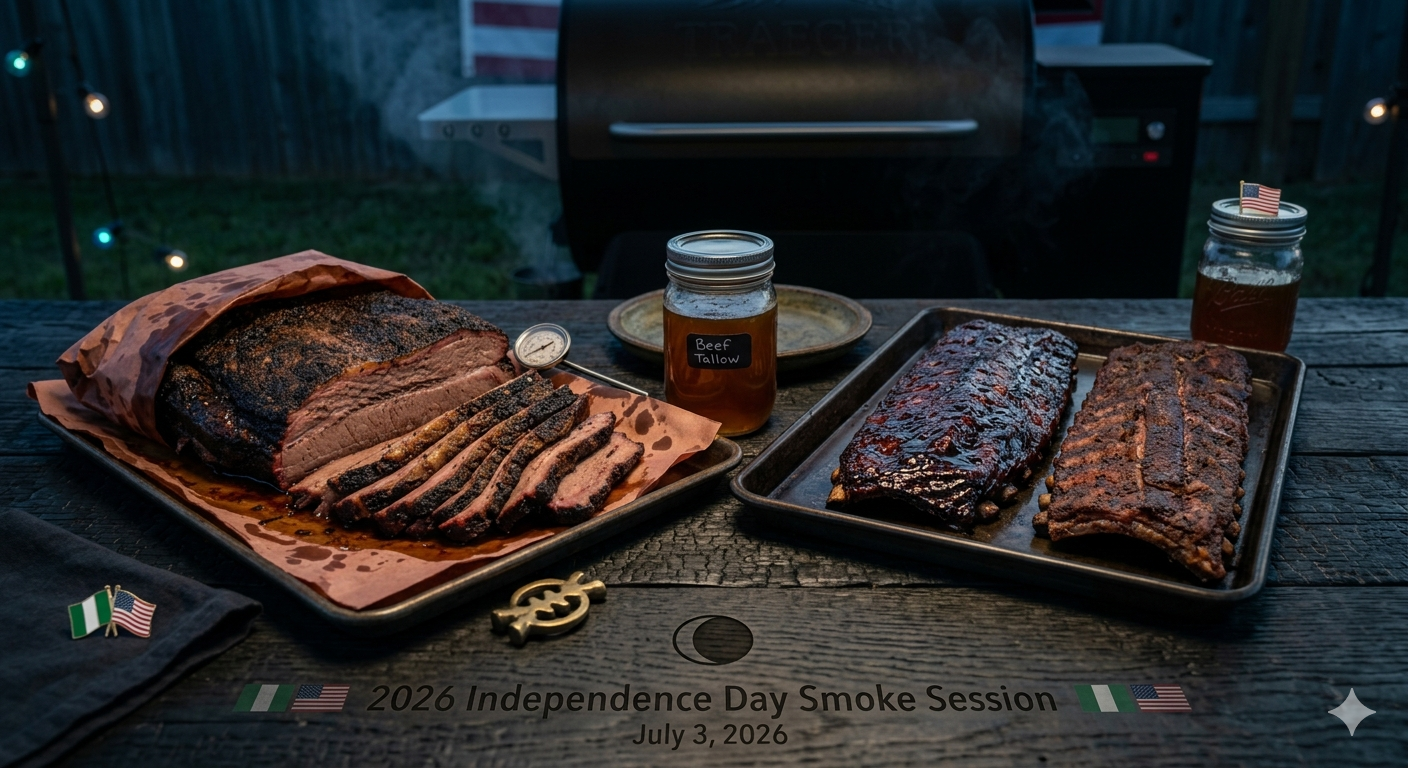
US 2026 Independence Day Smoke Session
Production execution log for the July 3, 2026 holiday smoke.
Objectives
Primary goals:
- Produce a Texas-style brisket.
- Smoke two racks of St. Louis style ribs.
- Render beef tallow from brisket trim.
- Validate several improvements to the Recipes knowledge base.
Equipment
- Traeger Woodridge Pro
- Wireless meat probes
- Butcher paper
- Cooling cooler for hot hold
- Mason jars for rendered tallow
Fuel Strategy
Primary Smoke Phase
Used premium smoke pellets:
- Smokin’ Pecan Pellets
- B&B Championship Blend
Purpose:
Maximize smoke flavor during the period when the meat accepts smoke most efficiently.
Finish Phase
After wrapping:
Switched to Kirkland Hardwood Pellets.
Reason:
Once wrapped, additional smoke contributes very little to flavor.
Premium pellets are reserved for the bark formation phase while inexpensive pellets provide efficient heat during the finish.
Decision: Adopt this as the standard pellet strategy.
Meat Preparation
Brisket
- Dry brined overnight
- Final seasoning applied prior to smoking
- Wrapped in butcher paper with rendered beef tallow
St. Louis Ribs
- Dry brined overnight
- Seasoned prior to smoking
Two racks were intentionally cooked using different finishing methods.
Timeline
Early Morning
Smoker operating at 225°F.
Brisket entered the stall normally.
Ribs were added later in the morning after approximately one hour at room temperature.
Super Smoke enabled during the early smoke phase.
Brisket Wrap
Brisket wrapped at approximately 165°F.
Added rendered beef tallow inside the butcher paper.
Temperature increased to 250°F after wrapping.
Rib Experiment
Rack A
- Smoked unwrapped
- Glazed late
- Returned to smoker unwrapped to set glaze
- Wrapped only after glaze bonded
Rack B
- Wrapped earlier
- Finished in butcher paper
- Unwrapped near completion
- Final glaze applied near the end
This became the primary experiment of the cook.
Final Cooking Phase
Temperature increased to approximately 255°F for the final portion of the cook.
Operational Incident
Unexpected Traeger Shutdown
The smoker unexpectedly entered its shutdown cycle during the cook.
The shutdown was noticed immediately because smoke production stopped and chamber temperature began falling.
Recovery actions:
- Did not open the lid.
- Allowed chamber heat to stabilize.
- Restarted the smoker.
- Returned to cooking temperature.
- Continued normal operation.
Maximum observed temperature loss was minimal and no noticeable impact occurred to the final product.
Lesson Learned
Do not panic.
Opening the lid would have caused significantly greater heat loss than allowing the smoker to recover naturally.
Rib Experiment Results
Rack A
Late glaze followed by glaze set on the grate.
Results:
- Excellent bark retention
- Beautiful glaze adhesion
- Firm exterior
- Traditional bite
Rack B
Wrapped earlier with glaze finishing near completion.
Results:
- Slightly softer exterior
- Excellent moisture
- Outstanding tenderness
Initial tasting was extremely positive.
Additional side-by-side comparisons will determine whether this becomes the preferred finishing method.
Brisket Results
Final pull decision was based on probe tenderness, not temperature alone.
Observations:
- Point section became probe tender first.
- Flat remained slightly firmer.
- Internal temperature remained only a guide.
- Probe feel ultimately determined removal.
Brisket transferred to insulated cooler for hot hold.
Planned slicing temperature:
Approximately 140°F internal.
Beef Tallow Production
Rendered brisket fat was strained after the cook.
Final yield:
- Two 3/4-cup mason jars
Total rendered tallow:
1½ cups
This tallow will be reserved for future brisket wraps and other beef cooks.
Major Lessons Learned
1. Smoke Early
Premium pellets provide the greatest benefit before wrapping.
After wrapping, economical hardwood pellets are sufficient.
2. Probe Tenderness Wins
Internal temperature remains a guide.
Probe feel determines completion.
3. Toothpick Testing
The toothpick test proved extremely useful for judging rib tenderness.
This will become a standard validation step.
4. Bark Before Wrap
Wrapping decisions should be based on bark development and tenderness—not a specific temperature.
5. Two Different Rib Finishes Both Work
Both finishing methods produced excellent ribs.
Future cooks should continue refining the preferred approach.
6. Stay Calm During Equipment Issues
The unexpected Traeger shutdown reinforced an important lesson:
Do not chase temperatures.
Avoid opening the lid.
Restore normal operation and continue cooking.
Runbook Updates Generated
This cook resulted in updates to:
- St. Louis Style Ribs Runbook
- Future Brisket Runbook
- Pellet Management Technique
- Tenderness Testing Technique
- Beef Tallow Rendering Technique
Overall Assessment
Overall Success: Excellent
Objectives achieved:
- Excellent brisket
- Two successful rib finishes
- Successful tallow rendering
- Multiple improvements identified for the Recipes knowledge base
- New operational standards established for future cooks
“Every cook should improve the system.”
This session successfully generated multiple refinements that will be incorporated into future runbooks.